Key Points
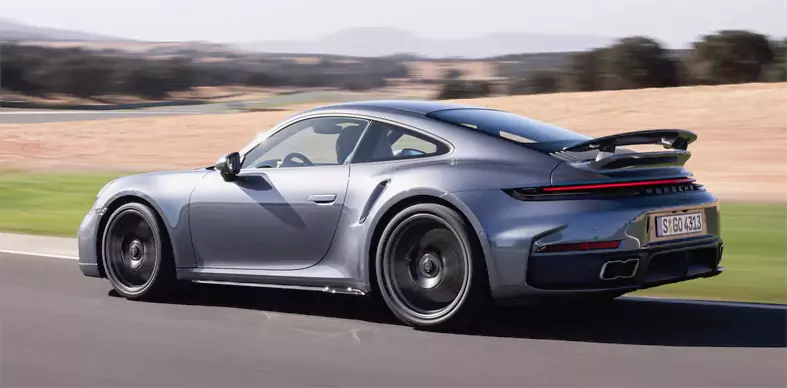
– The 2026 Porsche 911 Turbo S Hybrid attracted attention by completing the 0–60 mph sprint in just 2.0 seconds in independent testing by Car and Driver.
– This measurement was taken assuming a 1-foot rollout; removing the rollout results in a time of approximately 2.2 seconds.
– A VBOX data logger, GLONASS satellites, and a GPS base station were used for accurate measurements during testing; runs were performed in both directions and averaged.
– The Porsche outperforms many expensive hypercars in initial acceleration, but at speeds above 100 mph, it’s overtaken by the Chevrolet Corvette ZR1X and some other competitors.
Powertrain and Technology
– Engine and setup: Rear-mounted, heavily revised 3.6-liter twin-turbo flat-6 engine.
– Hybrid components: Electrically assisted turbocharger, ≈80-hp electric motor integrated into the eight-speed PDK transmission, and a compact lithium-ion battery in the front.
– Combined output is approximately 701 horsepower (523 kW) and 590 lb-ft (800 Nm) of torque.
– The electric turbo and electric motor effectively eliminate traditional turbo lag, resulting in immediate and sharp throttle response.
Performance Stats
– 0–60 mph: 2.0 seconds (with a 1-ft rollout).
– 0–100 mph (≈0–160 km/h): approximately 4.8 seconds.
– Quarter-mile: approximately 9.7 seconds.
– Indicated dealer-list price: approximately $270,300.
– According to Porsche, the car can reach speeds of up to 200 mph (≈320 km/h) if given the proper runway.
Rolling and Mid-Ranges
– 5–60 mph rolling acceleration is approximately 2.7 seconds—about a second faster than previous Turbo models.
– The electric motor inside the PDK proved helpful in both initial acceleration and rolling sprints.
– The electrically assisted turbo provided instant low-end and mid-range torque, which will also be beneficial in city and tunnel overtaking.
Independent Testing and Measurement Methodology
– Car and Driver’s process averaged runs in both directions; this is traditional and standardized protocol.
– The equipment used included a high-resolution VBOX and satellite/base station sync, providing position accuracy within an inch.
– Clear rollout announcements keep the comparison transparent—speaker-reported times with rollout are considered more favorable.
Rival Comparison — Corvette ZR1X
– Initial Sprint: The Porsche Turbo S holds top initial acceleration numbers; it often leads in 0–60.
– High-Speed Sequence: The ZR1X outpaces the Turbo S around 100 mph and holds a lead of approximately 2.6 seconds near 150 mph.
– Quarter-Mile: The ZR1X recorded a 9.2-second run around 155 mph—indicating better stability at high speeds.
Rival Comparison — Ferrari SF90 Stradale and Porsche 918
– The SF90 Stradale (~1,000 hp) outperforms the Turbo S in some high-speed segments; The SF90’s advantage remained clear in the 100–150 mph range.
– The Porsche 918 Spyder (the previous halo model) had a 0–60 time of approximately 2.1 seconds—marginally slower than the Turbo S. However, the 918’s top-end performance around 150 mph showed a slight improvement.
– The 918 and Turbo S performed quite closely in quarter-mile times.
Weight vs. Benefit—The Hybrid Equation
– The Turbo S, now a hybrid, is heavier than the previous version; the impact of the battery and electric components on weight is evident.
– Despite this, the electric boost and higher output mitigated the impact of the additional weight—evident in initial acceleration and rolling performance.
– Porsche offset the negatives associated with weight through both software and hardware improvements in coupling, suspension, and electronic traction mapping.
Driving Experience and Practical Use
– Throttle Response: Immediate, sharp, and predictable; This increases sensitivity to driver control.
– Useful on both track and street: With a track setup, it’s highly competitive; even in street use, it’s smooth and controllable.
– In everyday driving, electric assistance will be helpful for low-speed torque and overtaking, but fuel economy will depend on real-world use.
Limitations and Notes
– Car and Driver’s testing is independent and comprehensive, but a single testing setup doesn’t reflect all conditions—tire selection, weather, altitude, and road surface can alter results.
– Numbers like 0–60 and quarter-mile times give a lifetime rating; in real-world terms, driver skill and conditions will be crucial.
– Cars that perform better at high speeds often excel on the track due to their high stability and torque curve—this isn’t always linked to initial acceleration.
Commercial and Technical Impact
– Porsche’s electrified turbocharger and integrated motor approach shows that performance manufacturers are viewing hybrid technology not just as an eco-imperative but as a performance tool.
– This approach will influence the design of future high-performance sports cars, especially when balanced weight and software-driven control become key.
– For the brand, it is confirmation that even traditional engine specialists can gain a competitive edge with electric assistance.
– The 2026 Porsche 911 Turbo S Hybrid has achieved short-range acceleration.