
Electric Car Runs on 500 Old Batteries: UK Man Drives 30 km Using Discarded Cells
In the United Kingdom, a man named Chris Dole has demonstrated how an electric car can run using hundreds of discarded batteries. In a unique experiment, he powered a small electric vehicle using nearly 500 old battery cells.
The car managed to travel around 30 kilometers on a single charge. This experiment not only saved the cost of buying new batteries but also showed that old battery cells can still have practical uses. Here’s how Chris managed to make it work.
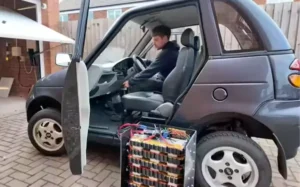
Using 500 Old Batteries to Power a Car
People often throw away old batteries thinking they are no longer useful. However, many lithium cells still retain some usable capacity. Chris collected around 500 discarded electronic batteries and decided to give them a second life.
He carefully tested each individual battery cell to check whether it was still functioning properly. After identifying the usable ones, he assembled them together to create a large battery pack capable of powering an electric car.
Chris has also shared the complete project on his YouTube channel, where viewers can watch the entire process of building the battery pack and installing it in the vehicle.
Which Car Was Used?
For this project, Chris used a small electric car called the REVA G‑Wiz. In India, this vehicle was simply known as the REVA.
The car is compact and lightweight, weighing around 400 kilograms without its battery pack. It is powered by a small 17-horsepower electric motor, which allows it to reach a top speed of approximately 80 km/h.
Battery Design and Capacity
The 500 battery cells were arranged into 14 separate modules to form the battery pack. Together, the system produces about 50 volts of electricity.
The total energy capacity of the pack is around 2.1 kWh. Before installing it in the car, Chris initially used these batteries to power lights and equipment in his workshop to ensure they worked reliably.
Special Focus on Safety
Using old batteries can be risky, so safety was one of the biggest challenges in this project. To manage this, Chris installed a dedicated battery management system that continuously monitors the voltage and temperature of each cell.
If any battery overheats, a small alarm immediately alerts the user. In addition, fuses and insulation tape were used across the system to reduce the risk of short circuits or fire.
Performance During Testing
During road testing, the car performed surprisingly well. It comfortably reached speeds of around 50–55 km/h without any major issues.
While climbing uphill required more power, downhill braking helped recharge the battery through regenerative braking. On a full charge, the car managed to cover around 30 kilometers.
One of the most interesting parts of the project is that the battery pack can even be charged using a USB-C laptop charger. Although this setup is not suitable for long journeys, it can still be practical for short city trips.