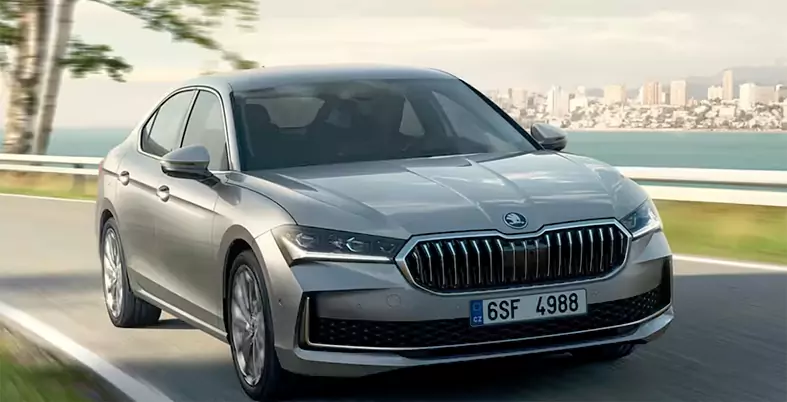
Russian buyers are turning away from Chinese cars and increasingly choosing models such as the Mazda CX‑5, Skoda Superb and Volkswagen Tharu — sales of these non‑Chinese models jumped roughly twentyfold in 2026.
Market context and overall trend While demand for Chinese brands in Russia fell sharply — Gazprombank Autoleasing estimates a 28.3% drop in February — sales of global marques rose. Overall shipments of foreign brands in Russia climbed 2.5× in 2026 to about 24,400 units, according to earlier reports. Avtostat CEO Sergey Tselikov has now released the list of the 20 most popular models this year, illustrating a clear consumer pivot.
Top sellers The Mazda CX‑5 crossover, produced in China but sold under the Japanese brand, was the runaway bestseller, accounting for 18.2% of segment sales with more than 4,400 units. Toyota followed with two strong performers: the RAV4 (≈1,500 units, 6.1% share) and the Highlander (1,134 units, 4.6% share).
Surprising entries and the top five
- Mazda CX‑5: ~4,400 units (18.2%)
- Toyota RAV4: ~1,500 units (6.1%)
- Toyota Highlander: 1,134 units (4.6%)
- Skoda Superb liftback: 976 units
- Kia Seltos crossover: 763 units
The Czech Skoda Superb and Korean Kia Seltos unexpectedly cracked the top five, highlighting diverse buyer preferences across segments.
Top ten and broader lineup Rounding out the top ten bestsellers were the BMW X3, Volkswagen Tiguan, Nissan Qashqai, Audi Q5 and Volkswagen Tharu. The second half of the top‑20 is dominated by German and Japanese models, including the BMW X5, Volkswagen Teramont, Lexus RX, Hyundai Tucson, Honda Vezel and Honda CR‑V.
Notable outlier: RAM 1500 A standout is the American RAM 1500 pickup, which claimed 14th place. Despite the market’s idiosyncrasies, the RAM 1500 logged steady demand with 375 units sold in two months — a 122% year‑on‑year increase.
What this shift means The data suggest Russian consumers are favoring established global nameplates and model lines that combine perceived reliability, resale value and available local supply. Even models assembled in China but carrying global brands (like the Mazda CX‑5) are benefiting. The decline in Chinese‑brand sales likely reflects shifting consumer sentiment, changing distribution dynamics and competitive pressure from reintroduced global models.
Implications for automakers
- Global brands with local or regional assembly lines are gaining traction.
- Chinese brands face an uphill challenge in restoring market share.
- Segment winners span compact crossovers to premium SUVs and even pickups, indicating broad-based interest in diverse vehicle types.
Quick takeaway Russian buyers are reallocating spending toward well‑known global models — the Mazda CX‑5 leads the recovery, while brands from Japan, Germany and Korea fill out the renewed demand.