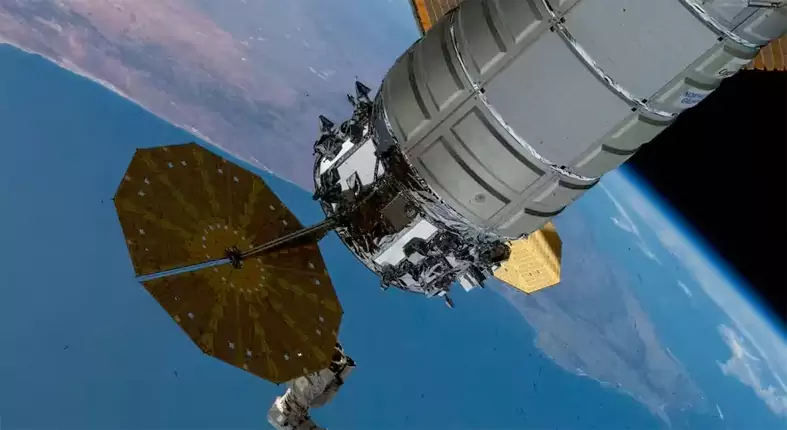
Cygnus XL completes first mission to ISS, sets payload record and returns for controlled reentry.
Northrop Grumman’s Cygnus XL departed the ISS after delivering a record payload.
On March 12, Cygnus XL completed its maiden mission to the ISS. The spacecraft, named SS William “Willie” McCool for Columbia astronaut William McCool, undocked from the Unity module via Canadarm2 and was released for a controlled atmospheric reentry over the South Pacific.
Cygnus XL launched Sept. 14, 2025, on a Falcon 9, delivering about 4,990 kg of equipment and supplies to the ISS — a Cygnus-series record (previous max: 3,856 kg). Despite an engine failure en route, the spacecraft arrived at the ISS about 24 hours late.
Cygnus XL is the first of Northrop Grumman’s new-generation cargo ships, offering increased capacity and upgraded systems. The mission demonstrated the platform’s resilience under challenging conditions.
Cygnus XL joins Dragon (SpaceX), Progress (Russia) and HTV-X (Japan) as one of four cargo spacecraft serving the ISS. Unlike SpaceX’s Dragon, Cygnus XL is not reusable and is disposed of via atmospheric reentry after its mission.