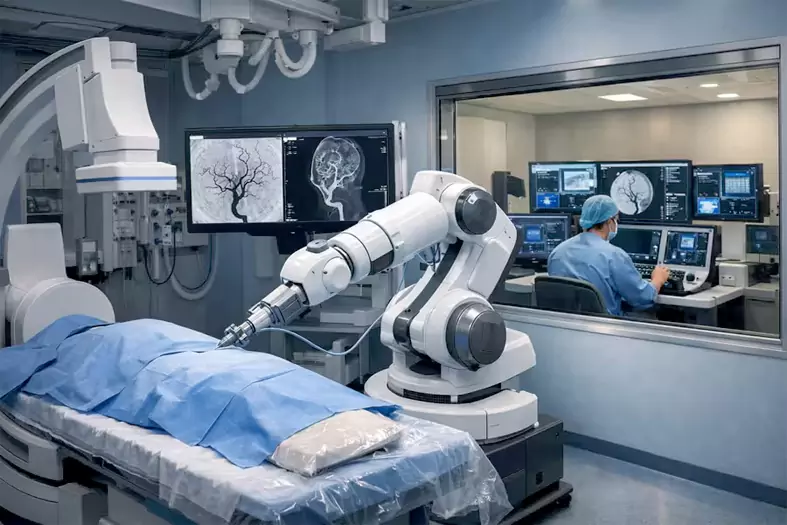
China Tests Robotic System for Brain Diagnostics: China has successfully conducted clinical trials of the YDHB-NS01 robotic system designed for cerebral angiography—a highly complex procedure used to diagnose brain diseases. The trials were carried out at Peking Union Medical College Hospital, highlighting a major advancement in medical robotics.
The YDHB-NS01 system demonstrated performance comparable to experienced doctors while significantly reducing the workload on surgeons and minimizing radiation exposure. During testing, the robotic system reduced the average procedure time by 29%, bringing it down from 38 minutes to just 27 minutes.
Cerebral angiography typically requires doctors to manually guide a wire from the hip to the brain, a process that demands precision and can lead to fatigue and small errors. The robotic system eliminates these challenges by enabling surgeons to operate remotely from a secure console with enhanced control and accuracy.
A controlled study involving 50 patients compared 25 robotic-assisted procedures with 25 traditional manual procedures. Both methods achieved a 100% success rate, confirming the reliability and diagnostic accuracy of the robotic system without any mechanical failures.
The system also delivered high-quality vascular imaging, meeting all requirements for diagnosing conditions such as aneurysms and arterial stenosis. Importantly, there were no differences in radiation exposure, fluoroscopy time, or contrast agent usage between robotic and manual procedures.
Even a young neurosurgeon with less than three years of experience was able to successfully operate the system, avoiding physical strain and radiation risks.
According to lead researcher Zhao Yuanli, the results are promising but still preliminary. He emphasized that larger, multi-center studies will be necessary to fully validate the effectiveness of the YDHB-NS01 system.
Overall, this innovation represents a significant step forward in medical technology, offering a safer, more efficient, and highly precise approach to diagnosing brain diseases.