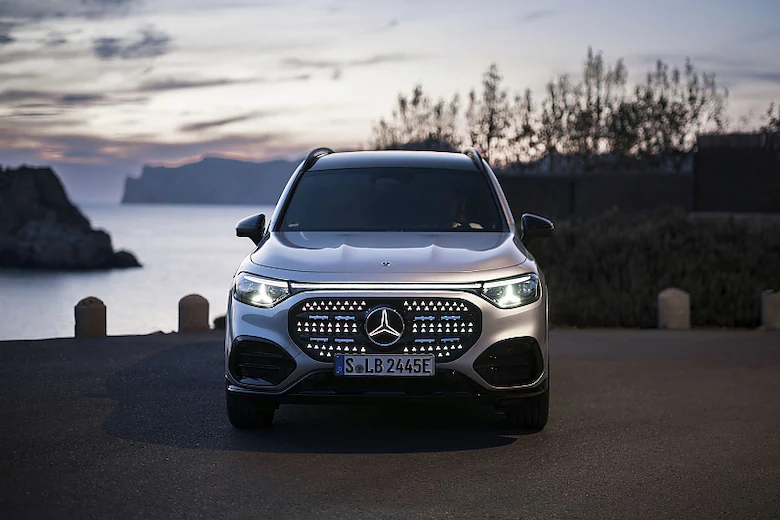
Mercedes has launched the second generation of the GLB. The compact electric SUV stands out with its spacious interior, balanced driving experience, and modern technology, although it still has some shortcomings.
At Mercedes, the mood has been tense. Business didn’t perform particularly well last year, which came as a setback for the success-driven Swabian brand. A large-scale product offensive is now planned to turn things around. Alongside a refreshed S-Class, the second-generation GLB is expected to bring fresh appeal to the streets and boost sales. This update was long overdue. While the first GLB performed well financially, the compact electric SUV had gradually become technologically outdated—especially in the fast-evolving world of electromobility.
Lots of Space at Mercedes – But Too Much Plastic
The new GLB aims to improve the situation while retaining the strengths of its predecessor. That means plenty of space in the compact segment, along with an optional seven-seat configuration. This makes it appealing to buyers who found the GLC too large, the GLA too cramped, and the EQB too plain.
However, the interior is not without criticism. The use of hard plastics is excessive for a car starting at €53,454.80, and even more disappointing in the test model priced at €62,177.50 (excluding extras). This is especially surprising considering Mercedes CEO Ola Källenius’ recent focus on a luxury-oriented strategy.
That said, Mercedes gets several things right with the GLB—particularly its space management. The wide-opening rear doors make entry easy, and the second row is comfortable, with adjustable seating that slides up to 14 cm. For a vehicle measuring 4.73 meters in length with a 2.89-meter wheelbase, space is used efficiently. The third row, as expected, is best suited for short trips.
The GLB remains a practical family car. Boot capacity stands at 540 liters (five-seater) and 480 liters (seven-seater), expanding to 1,715 and 1,605 liters respectively with the rear seats folded. Additionally, a 127-liter front trunk (frunk) adds extra storage. With this practicality and charging capability, the GLB is well-suited for long-distance travel—provided charging infrastructure is available.
CLA-Inspired Cockpit
The GLB’s cockpit is similar to that of the CLA. Buyers can opt for the MBUX Superscreen setup, which includes a 10.25-inch digital instrument cluster and two 14-inch displays—one central touchscreen and an optional passenger display. The system is visually impressive and competitive with rivals.
Initially, the extensive menu system may feel overwhelming, but it becomes intuitive with use. The voice assistant has also improved significantly. The “Hey Mercedes” system now integrates Google Maps and supports AI tools like Microsoft ChatGPT and Google Gemini.
Mercedes has also responded to customer feedback by reintroducing physical controls on the steering wheel, including a volume roller and cruise control rocker. While touch-sensitive elements remain, this shift improves usability.
High Charging Power and Impressive Range
Technically, the GLB is based on the Mercedes Modular Architecture (MMA), similar to the CLA. It features an 800-volt system capable of charging at up to 320 kW. According to Mercedes, it can add up to 260 km of WLTP range in just 10 minutes, while charging from 10% to 80% takes around 22 minutes.
The GLB 350 4MATIC offers a WLTP range of up to 614 km, slightly lower than the rear-wheel-drive 250+ variant. However, this trade-off is justified by better traction and higher performance.
The rear axle houses a 200 kW (272 hp) permanent magnet synchronous motor (PSM) paired with a two-speed gearbox, while the front motor produces 80 kW (109 hp). Combined, the system delivers 260 kW (354 hp) and 515 Nm of torque. This allows the 2,275 kg SUV to accelerate from 0 to 100 km/h in just 5.5 seconds, with a top speed of 210 km/h.
Comfortable Yet Capable Performance
Despite its weight, the GLB delivers strong performance suitable for European highways. Its adaptive suspension is one of its key strengths, offering a well-balanced ride without being overly stiff—even in Sport mode.
In everyday driving, Comfort mode feels more appropriate, though slight body movement and somewhat artificial steering feedback are noticeable. However, this aligns with the GLB’s character as a family-oriented SUV rather than a performance-focused model.
During testing, the average energy consumption was recorded at 17.2 kWh/100 km, slightly higher than the official figure of 15.9 kWh/100 km.