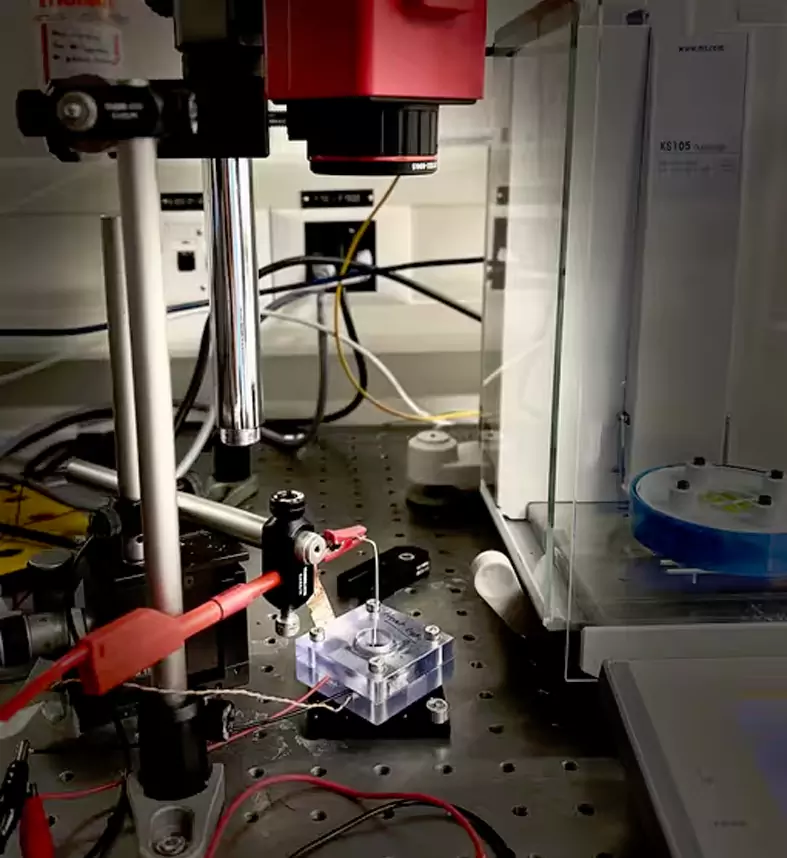
Researchers from École Polytechnique Fédérale de Lausanne (EPFL) have developed an advanced nanodevice that produces a steady electric current using salt water evaporation, sunlight, and heat. The system operates autonomously without batteries by harnessing the movement of ions and electrons inside a silicon structure.
Built on the hydrovoltaic effect
The team previously created a platform to study the hydrovoltaic effect — a phenomenon where electricity is generated when liquid flows across a charged nanostructured surface. Their earlier design used a lattice of silicon nanopillars that formed channels for evaporating liquid.
The new device significantly improves on that concept, delivering comparable or higher power than similar technologies.
What makes the new design different
Earlier hydrovoltaic systems mainly used heat and light to speed up evaporation. In contrast, the new EPFL device uses them to actively control:
-
Ion movement in water
-
Electron behavior in the semiconductor
This direct control enables stronger electrical output.
Three-layer architecture
The nanodevice features three independent functional layers:
-
Evaporation layer
-
Ion transport layer
-
Electric charge collection layer
Separating these stages allows researchers to precisely tune performance parameters, including nanopillar geometry and salt concentration, while also monitoring each step of the energy generation process.
How the device generates power
The system combines multiple physical effects:
-
Sunlight photons excite electrons in silicon
-
Heat increases the material’s negative surface charge
-
Salt water evaporation drives ion displacement and charge separation
Together, these processes create an electric field at the water–solid interface, which directs excited electrons into an external circuit.
By adding light and heat, the researchers achieved roughly a fivefold increase in energy output. While the individual effects were known before, this is the first time they have been deliberately combined to enhance hydrovoltaic efficiency.
Performance and durability
Laboratory tests showed:
-
Output voltage: ~1 volt
-
Power density: ~0.25 W/m²
The device is also engineered for long-term stability. Silicon nanopillars are coated with a protective oxide layer that resists chemical degradation in salt water and under prolonged exposure to heat and light.
What comes next
By dividing the system into three functional layers, scientists created a detailed physical model that helps optimize performance. The team is now working on real-time monitoring techniques and conducting further experiments using a solar simulator.
Researchers believe this breakthrough could accelerate the real-world adoption of hydrovoltaic energy systems, especially for:
-
Battery-free sensor networks
-
Environmental monitoring
-
Wearable electronics
-
IoT devices
In environments where water, heat, and sunlight are readily available, this technology could offer a promising new source of self-sustaining power.