The AF Ioffe Physical-Technical Institute of the Russian Academy of Sciences is developing advanced quantum cascade lasers designed to enable atmospheric optical communication in harsh Arctic conditions, including fog, snow, and strong winds. The update was shared with RIA Novosti by senior research scientist Grigory Sokolovsky, a professor at the academy.
Why New Communication Technology Is Needed in the Arctic
At present, Arctic regions primarily rely on radiotelephone and satellite communication. Installing fiber-optic infrastructure across the region is both technically challenging and economically impractical.
An alternative approach is open-beam atmospheric optical communication — a wireless method in which transmitters and receivers maintain direct line of sight to exchange data between ships, coastal stations, or different elevations.
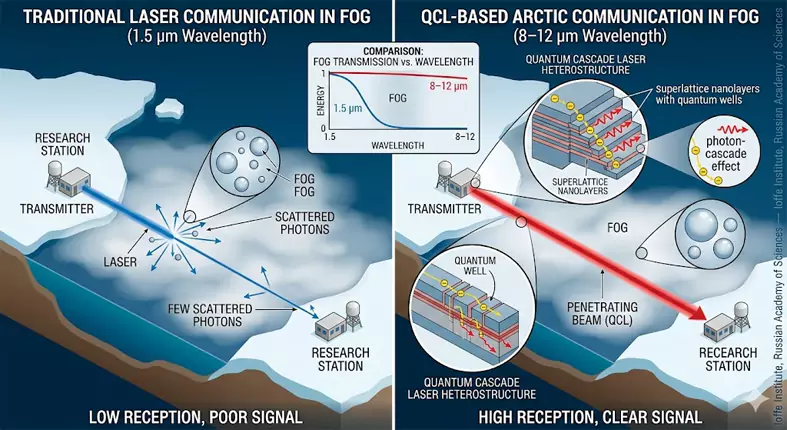
However, existing systems operating at wavelengths around 1.5 μm perform reliably only in clear weather. In foggy conditions, signal quality deteriorates rapidly and can fail entirely.
How Quantum Cascade Lasers Solve the Problem
Researchers propose shifting to longer wavelengths — specifically 4–5 μm or 8–12 μm — where radiation penetrates fog and precipitation much more effectively.
This is where quantum cascade lasers (QCLs) become critical. Unlike conventional semiconductor diodes, QCLs operate using only electrons. When voltage is applied, electrons move through discrete quantum energy levels within nanometer-scale heterostructures, producing mid-infrared radiation.
Despite their promise, the technology remains complex and still requires further refinement before large-scale industrial deployment.
Successful Real-World Testing in 2025
The first practical results have already been demonstrated. In autumn 2025, in Sarov, specialists from the Russian Federal Nuclear Research Center – VNIIEF successfully transmitted and received data under real-world conditions.
The system achieved speeds of 0.1 Gbit/s using a quantum cascade laser operating at approximately 8 μm wavelength at room temperature. The laser itself was developed at the Ioffe Institute.
Potential Applications Beyond Communications
Beyond Arctic communications, quantum cascade lasers could enable several high-value applications, including:
-
Remote detection of pipeline leaks
-
Field environmental monitoring
-
Fuel quality control
-
Breath analysis for medical diagnostics
What Comes Next
According to Sokolovsky, several technical challenges must still be addressed before a fully weather-resistant optical communication system becomes commercially viable. These include increasing laser power and modulation speed, developing highly sensitive receivers, and creating precise beam-guidance systems.
Multiple leading Russian research institutes are now joining the project, signaling continued momentum toward next-generation Arctic communication infrastructure.