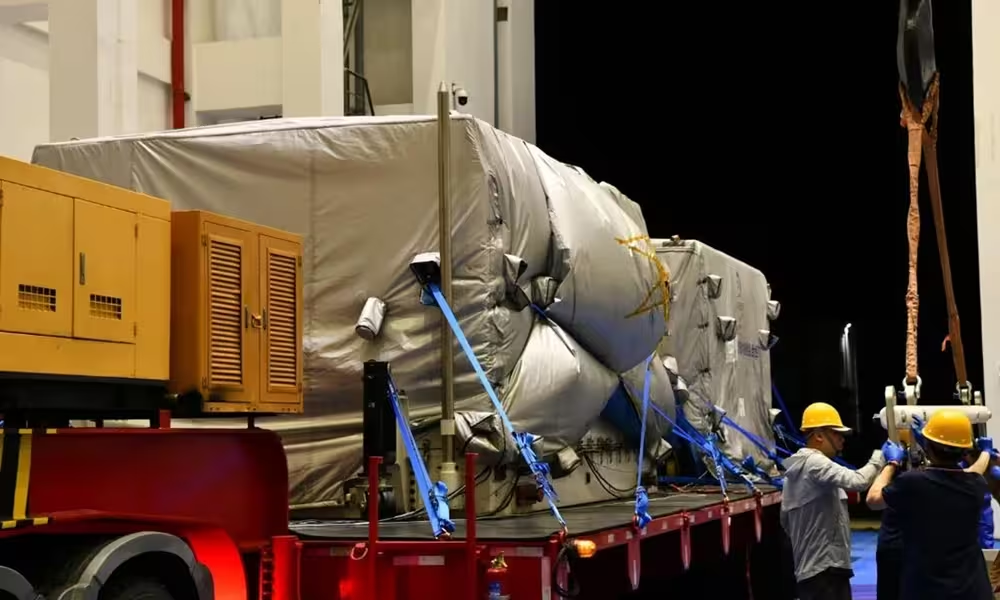
China is preparing for the launch of its Chang’e-7 mission, with the probe successfully delivered to the Wenchang Satellite Launch Center.
The spacecraft has arrived in Hainan Province, where pre-launch testing and final preparations are now underway. According to the China Manned Space Administration, all mission components were safely transported by the evening of April 9.
The Chang’e-7 mission is scheduled for launch in the second half of 2026. Officials at the launch center have confirmed that all infrastructure and equipment are fully operational, and preparations are progressing on schedule.
The mission’s primary objective is to test critical technologies required for future lunar exploration. These include high-precision soft landing capabilities, mobility systems such as hopping mechanisms, and advanced surface exploration techniques. A key focus will be the study of permanently shadowed craters at the Moon’s south pole, which are believed to contain water ice deposits.
Chang’e-7 will employ a complex mission architecture consisting of an orbiter, a lander, a rover, and a hopper module. This integrated approach will allow scientists to conduct a comprehensive analysis of the lunar environment and available resources.
The lunar south pole is considered a strategic target for future human missions due to its potential water reserves and relatively stable lighting conditions. As part of the mission, China also aims to expand international cooperation in lunar exploration.
This initiative is a key component of China’s broader lunar strategy, which seeks to combine both manned and unmanned missions to enhance overall capabilities and pave the way for a future human landing on the Moon.