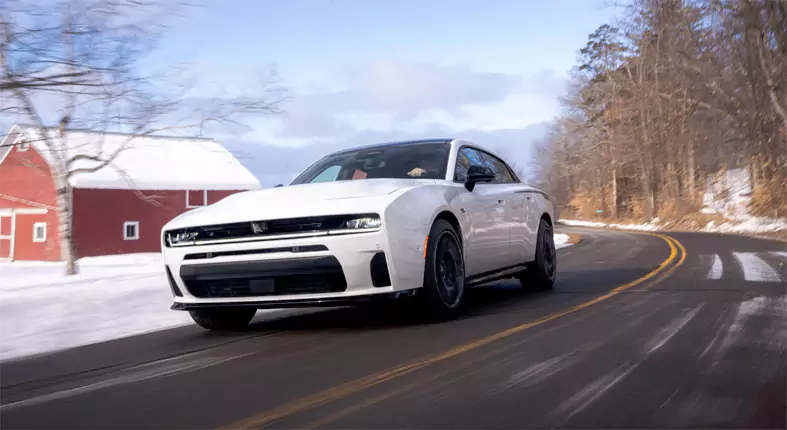
Dodge has quietly reinterpreted what “more performance” means for the Charger lineup. The latest Charger R/T and Scat Pack models abandon the long‑standing 5.7‑litre Hemi V8 in favour of advanced twin‑turbocharged inline‑six engines. That shift isn’t just about emissions or packaging: Dodge says the new powertrains deliver measurable gains in horsepower, torque and acceleration that more than compensate for the reduction in displacement. For enthusiasts, the change marks the end of an era — but for buyers focused on timeslips and real‑world performance, the math now favours the six‑cylinder units.
What changed: displacement vs. real‑world output For roughly a decade and a half the Charger R/T’s identity was wrapped up in the 5.7‑litre Hemi V8. That engine defined the model’s sound, linear torque and muscle‑car heritage. Dodge’s new approach swaps the naturally aspirated V8 for a twin‑turbo 3.0‑litre inline‑six in the R/T and a higher‑output Hurricane inline‑six in the Scat Pack. The company’s claim is simple: smaller displacement but forced induction yields more usable power, better torque and quicker acceleration — the performance metrics most buyers actually experience.
- Charger R/T (inline‑six): 420 hp (313 kW / 426 PS) and 468 lb‑ft (634 Nm) torque.
- Power increase over previous 5.7‑litre V8: +50 hp and +73 lb‑ft.
- 0–60 mph in 4.6 seconds; quarter‑mile in 12.9 seconds — improvements over the V8’s 5.1s and 13.5s respectively.
Why the numbers matter Switching to turbocharged six‑cylinders alters the performance envelope. Peak torque arrives earlier and is higher overall, improving off‑the‑line response and midrange punch — the areas most drivers notice in everyday and spirited driving. The R/T’s 0–60 time droppage of roughly 0.5 seconds is significant: in real‑world overtakes, on‑ramps and track sprints, that margin translates directly into perceived agility.
Scat Pack: the higher‑output proposition Dodge’s Scat Pack retains its performance halo but ramps it up. The Scat Pack’s Hurricane inline‑six produces roughly 550 hp (410 kW / 558 PS) and 531 lb‑ft (719 Nm), according to Dodge. Those outputs push the Scat Pack to a 0–60 mph figure of about 3.9 seconds and a top speed near 177 mph (285 km/h). In short, the Scat Pack now competes with the quickest modern muscle cars while offering drivetrain flexibility (AWD to RWD transition) and more compact, efficient architecture compared to a large V8.
Transmission, driveline and driving modes Both cars pair the inline‑six engines with modern transmissions tuned for the torque profile of turbocharged units, and Dodge emphasizes drivability. The Scat Pack’s ability to switch from all‑wheel drive to rear‑wheel drive on demand is a notable selling point: AWD improves traction in poor conditions and off the line, while RWD retains the traditional muscle‑car dynamics for enthusiasts on dry pavement or the track.
Packaging and practical advantages The move to an inline‑six provides packaging benefits. A smaller, more compact engine bay footprint improves crash structure options, weight distribution and cabin packaging potential. Dodge also argues that the Charger remains a practical daily driver: CEO Matt McLeodier (sic — Matt McClary in earlier reports) stresses the model’s everyday usability, award‑winning interior and class‑leading cargo volume. Price positioning is part of the equation as well: Dodge bills the Charger R/T as the most affordable all‑wheel‑drive muscle car in the U.S., starting at $49,995, though that entry figure positions the R/T well above prior V8‑equipped base prices.
Pricing context The new R/T’s starting price is notable. Previous generations were significantly cheaper at launch: the 2023 Challenger R/T started near $39,385 and the earlier Charger R/T retailed around $42,385. Dodge has reduced the sedan’s price slightly from one prior configuration by $2,000, but the R/T’s AWD hardware and forced‑induction power justify higher MSRP relative to legacy V8 models. Buyers should weigh the improved acceleration and torque curve against the higher sticker price and the intangible value some attach to a naturally aspirated V8.
Fan reaction and emotional acceptance Dodge faces a delicate cultural challenge. For many enthusiasts the Hemi V8 represents not just power but identity: sound, lineage and the sensory package of torque‑heavy, naturally aspirated muscle. While many fans welcome the retention of an internal combustion engine rather than full electrification, adapting to an inline‑six with turbochargers will take time. The new engines provide a different character — faster, more forceful at lower revs, but lacking the traditional Hemi growl and linear V8 response. That tradeoff will split buyers on emotional grounds even as the data favours the new units for pure performance.
Collector vs. buyer mindset Those who buy for collector value or nostalgia may see older V8 Chargers as more desirable in the long term. Conversely, performance buyers who prioritize lap times, daily drivability and all‑weather capability will likely be attracted to the new R/T and Scat Pack. Dodge appears to be hedging both bets: keep the ethos of a practical, hard‑charging sedan while modernizing the heart of the car.
Marketing push: Scat Pack video series To support the transition, Dodge launched a short video series to spotlight the Scat Pack. Hosted by boosted motorsports personality John O’Malley, the five‑clip campaign focuses tightly on the car’s headline features — notably the Hurricane inline‑six delivering 550 hp and the car’s AWD/RWD flexibility. The clips are brief (about a minute each), geared for social feeds, and crafted to demonstrate real world and track dynamics rather than deep tech explanations. The series is a clear attempt to shape narrative: show the capability, emphasize speed and versatility, and normalize the inline‑six as the new performance metric.
H3 — Why short clips work Short, punchy video content matches how many buyers research cars today. Quick demonstrations of launch performance, the AWD‑to‑RWD transition, and closeups of engine/exhaust notes can shift sentiment faster than long technical briefings. Dodge’s choice of a recognizable host from the aftermarket and motorsport scene lends credibility to the car’s track chops.
Technical considerations and maintenance implications Moving to turbocharged inline‑sixes brings new maintenance tradeoffs. Turbo systems increase complexity: intercoolers, boost control hardware, additional cooling, and higher intake pressures can affect long‑term reliability and maintenance costs compared with a naturally aspirated V8. However, modern forced‑induction engines are increasingly durable if maintained properly. Owners should expect heat management systems, oil change intervals and cooling system checks to be more critical. Parts costs for a sophisticated turbo setup may also be higher than for an older, simpler Hemi.
Aftermarket and tuning potential Tuning culture will likely embrace the Hurricane inline‑six quickly. Turbo engines respond strongly to boost, fueling and airflow upgrades, which can yield substantial power gains. The Scat Pack’s 550 hp baseline suggests significant headroom for aftermarket tuners. Conversely, vintage Hemi owners may prize the relative simplicity and lower tuning complexity of the V8.
Performance summary and competitive positioning On raw performance metrics, Dodge’s strategy checks out: the new R/T is quicker and torquier than the outgoing 5.7‑litre V8, and the Scat Pack joins the upper echelon of modern muscle cars with a sub‑4.0‑second 0–60. Dodge now competes not by clinging to displacement but by delivering seat‑of‑the‑pants acceleration, consistent track times and all‑condition usability. This approach may broaden the Charger’s appeal to buyers who previously dismissed large‑displacement engines for drivability or efficiency concerns.
Tradeoffs for purists Purists will note the loss of V8 acoustic character and the emotional punch of a naturally aspirated rev. Still, for many consumers — especially those seeking a balance between daily usability and high performance — the inline‑six solution offers clear benefits.
Conclusion: A strategic gamble that bets on numbers and feel Dodge’s shift from Hemi V8s to twin‑turbo inline‑six engines in the Charger R/T and Scat Pack is a deliberate performance play. The company argues that better acceleration, higher torque and modern drivetrain versatility provide a superior driving package even without a large displacement V8. Early numbers support that claim: faster 0–60s, quicker quarter‑mile times and higher torque figures are tangible improvements. Whether the broader enthusiast community embraces the change will depend on how buyers weigh raw metrics against tradition. For consumers focused on timeslips, drivability and modern capability, Dodge’s bet appears sound. For purists, the new Chargers will require an adjustment — and perhaps a nostalgia‑driven premium paid for legacy V8 models in the years to come.
Quick tip If you’re evaluating the new Charger R/T or Scat Pack, arrange a back‑to‑back test drive with a previous V8 model to compare throttle response, sound and torque delivery under identical conditions.
Next step suggestion Collect full spec sheets, pricing details and a drive review comparison of an outgoing V8 Charger versus the new inline‑six R/T/Scat Pack, then run a controlled 0–60 and quarter‑mile test to validate Dodge’s performance claims.