Hopper E-Bike vs Xyte One: The Future of Urban Mobility with Weather Protection
Urban mobility is rapidly evolving, and not every solution needs to be a traditional electric car. In large cities, commuting by bicycle is often faster, cheaper, and more practical. You don’t have to worry about rising fuel prices or the daily struggle of finding parking. However, bad weather—especially rain—can make cycling uncomfortable.
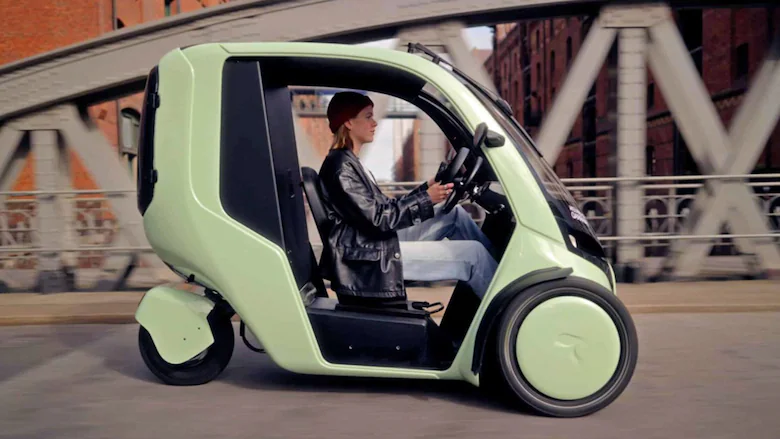
To solve this problem, a startup from Hamburg has developed an innovative solution: the Hopper—an e-bike with weather protection, three wheels, and electric pedal assistance. It’s designed to bridge the gap between bicycles and compact electric cars.
A Pedelec in Car-Like Form
The Hopper is a unique vehicle that combines the simplicity of a bicycle with the comfort of a small car. Measuring 2.12 meters in length and 1.50 meters in height, it offers a compact yet practical design.
Legally, it is classified as a pedelec, meaning:
- Powered by a 250-watt rear hub motor
- Electric assistance up to 25 km/h
- No driver’s license required
- No helmet or registration needed
- Allowed on cycle paths
This makes it an ideal solution for navigating through congested city traffic while avoiding long queues and delays.
Innovative Technology & Engineering
The Hopper introduces several unique technical features that set it apart from traditional e-bikes.
Pedal-by-Wire System
Instead of a conventional chain, the Hopper uses a “pedal-by-wire” system. Pedaling input is electronically transmitted to a 250W Heinzmann motor, reducing maintenance and improving efficiency.
Exceptional Maneuverability
- 90-degree rear-wheel steering
- Turning radius of less than 2 meters
Despite weighing around 140–150 kg, the Hopper remains extremely agile, making it perfect for tight urban streets.
Advanced Braking System
The braking setup is equally innovative:
- A hand-operated ring brake behind the steering wheel
- Additional rear disc brake via pedal input
- Integrated parking brake
This combination ensures safe and controlled stopping in various conditions.
All-Weather Comfort & Practicality
One of the Hopper’s biggest advantages is its enclosed cabin, which protects riders from rain, wind, and cold weather.
Key Comfort Features:
- Weatherproof cabin
- Window heating system for winter
- Charging via a standard household socket
The vehicle is powered by a 1440 Wh lithium-ion battery, offering a range of around 60 km, depending on usage. For longer journeys, an optional second battery can be added.
Two Variants for Everyday Use
The Hopper is available in two practical versions, both with a maximum permissible weight of 300 kg:
Hopper Passenger
- Seating for 1 adult in front + 1 adult or 2 children at the rear
- 125-liter trunk space
- Ideal for families and daily commuting
Hopper Cargo
- No rear seats
- Large 285-liter cargo space
- Perfect for deliveries, shopping, or small businesses
This versatility makes the Hopper suitable for both personal and commercial use.
Xyte One: A High-Performance Alternative
Another innovative player in the micromobility space is Xyte Mobility with its Xyte One.
Unlike the Hopper, the Xyte One is a high-performance three-wheeled electric scooter, designed for longer commutes.
Key Highlights:
- 19 kW electric motor
- Top speed: 100 km/h
- Range: 100+ km
It is built using an aluminum space frame and includes safety features like a belt system. Interestingly, it can be driven with a standard car license and does not require a helmet under certain regulations.
This makes the Xyte One a strong alternative for suburban commuters traveling into the city.
Price Comparison: Premium Micromobility
Despite their differences, both vehicles are priced surprisingly close:
Hopper
- Passenger version: €11,900
- Cargo version: €12,300
Xyte One
- Launch edition: €12,900
The Xyte One competes with premium scooters like the BMW CE 04, but offers added benefits such as weather protection and enhanced safety.
The Rise of Smart Urban Mobility
Both the Hopper and Xyte One represent a new wave of micromobility solutions that prioritize:
- Sustainability
- Efficiency
- Comfort
- Urban practicality
The Hopper focuses on eco-friendly, short-distance commuting, especially for city centers and bike lanes. Meanwhile, the Xyte One targets longer suburban commutes with higher speed and performance.
Conclusion
The Hopper e-bike demonstrates how innovative thinking can solve everyday urban challenges. By combining bicycle flexibility with car-like protection, it offers a practical and sustainable commuting solution—especially for rainy or cold climates.
On the other hand, the Xyte One pushes the boundaries of micromobility with higher speed and performance, catering to a different set of users.
With over 100 units already sold, the Hopper has proven that there is real demand for such hybrid mobility solutions. As cities continue to grow and congestion worsens, vehicles like these could play a crucial role in shaping the future of transportation.
Micromobility is no longer just an experiment—it’s becoming a necessity. And this revolution is only just beginning.