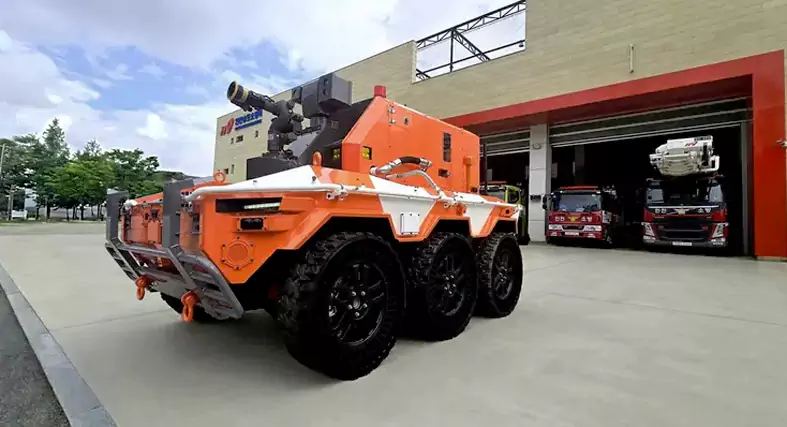
Hyundai Reveals AI Firefighting Robot for Extreme Conditions
Hyundai Motor Group has unveiled a new firefighting robot designed to operate in environments too dangerous for humans. The prototype is built to handle extreme heat, explosions, and dense smoke, helping emergency teams tackle the most hazardous stages of firefighting operations.
The main objective of the system is to reduce risks for firefighters and rescuers by allowing robots to enter high-risk zones first.
Advanced Technology and Remote Operation
The robot features remote control capabilities, along with an autonomous driving system that enables it to move through dangerous environments with minimal human input.
It is equipped with thermal imaging cameras, allowing operators to detect heat sources, identify fire hotspots, and navigate through smoke-filled areas.
The system is based on Hyundai’s HR-SHERPA multipurpose unmanned vehicle platform, which supports various robotic and autonomous applications.
Designed to Survive Extreme Heat
To operate in severe conditions, the robot includes a self-spraying water cooling system and specialized thermal insulation. These features protect sensitive components such as the battery and onboard electronics, allowing the machine to withstand temperatures of up to 800°C.
High Mobility in Disaster Zones
The robot uses six motorized wheels that allow it to:
-
Perform 360-degree turns
-
Reach speeds of up to 50 km/h
-
Climb over obstacles up to 300 mm high
This mobility enables it to navigate complex disaster environments, including industrial fires and collapsed structures.
Toward Autonomous Firefighting
Beyond extinguishing fires, the robot is also designed to collect operational data from the scene.
Hyundai describes the system as a form of “physical AI” that could eventually analyze fire conditions, identify the source of a blaze, and determine the optimal firefighting strategy without direct human control.
If fully developed, such technology could significantly change how emergency response teams handle high-risk fire situations.