
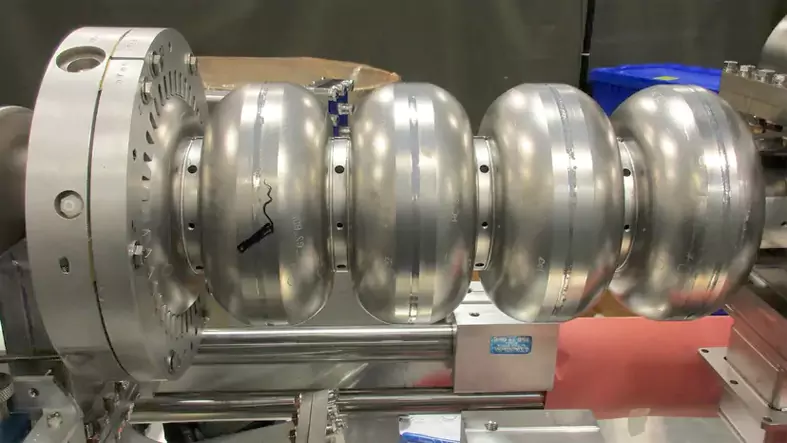

Particle accelerators are turning nuclear waste into an energy source.
Nuclear waste was long considered an insoluble problem, requiring storage for hundreds of thousands of years. Now, scientists are proposing not just isolating it, but using it as an energy source.
Researchers at the Jefferson National Accelerator Facility in the United States are developing an unusual system that uses an accelerator to direct high-energy protons toward a target—for example, liquid mercury. As a result, the neutron beam transmutes dangerous isotopes, reducing the lifespan of radioactivity from 100,000 years to approximately 300 years.
Most importantly, the reaction produces heat that can be used to generate energy. Scientists use tin-coated niobium chambers, which operate at higher temperatures and do not require expensive cooling.
Magnetrons with power of up to 10 MW and a frequency of 805 MHz are also used to drive the accelerator. The projects are funded by the U.S. Department of Energy under the NEWTON program. The authors aim to reprocess the entire commercial nuclear fuel stockpile in the United States within 30 years.
Source: interestingengineering.com