Engineers have developed soft–rigid robots that can move without motors, using heat and origami-inspired structures to generate motion.
A team from Princeton University has created hybrid robots powered by liquid crystal elastomers and embedded electronics, enabling movement through controlled deformation of the material rather than traditional mechanical systems.
Soft robots are designed for flexibility and smooth motion but typically rely on bulky motors or external pneumatic systems. The Princeton team addressed this limitation by combining advanced materials, flexible electronics, and 3D printing to create robots that move through controlled heating of a specialized polymer.
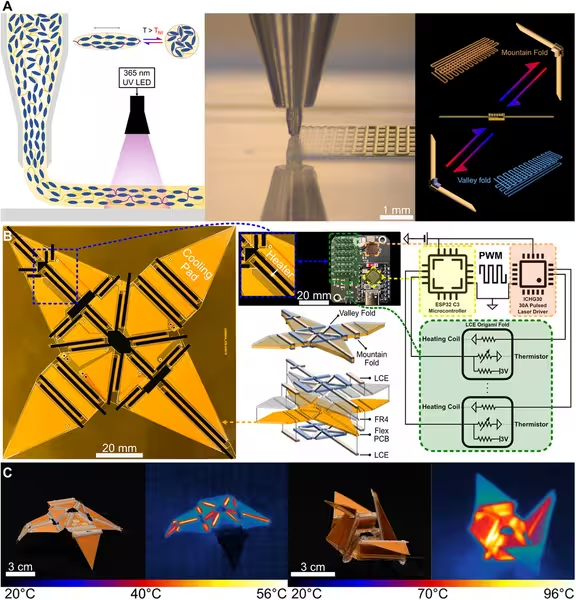
As a proof of concept, the researchers built a robot shaped like an origami crane. When an electric current is applied, specific areas of the structure heat up, causing the crane to flap its wings and perform programmable sequences of movement. This demonstrates the potential of the technology for future soft robotics applications.
Using a 3D printer, the team fabricated polymers with pre-designed patterned zones. The liquid crystal elastomer allows molecules to align into ordered structures. By programming the printing process, the researchers controlled molecular orientation to create built-in hinges. When heated, these hinges bend predictably, enabling controlled motion.
Flexible electronics were embedded directly into the material’s hinges, with bendable circuit boards integrated seamlessly into the structure. These components selectively heat targeted regions, while embedded temperature sensors provide a closed-loop control system, allowing the robot to respond dynamically in real time.
To ensure precise and repeatable movement, the team reinforced non-flexing sections with thin fiberglass panels attached to flexible circuit boards. This hybrid soft–rigid design enables stable operation without the need for motors.
Mathematical models based on origami principles were used to control folding and unfolding movements. According to co-author David Bershadsky from the University of Texas, the key innovation lies in integrating materials science, robotics, and advanced manufacturing.
Bershadsky also developed a software tool, available on GitHub, that helps users design custom robots. The tool incorporates findings from research published in Advanced Materials, making experimentation and development more accessible.
Sources: Advanced Materials