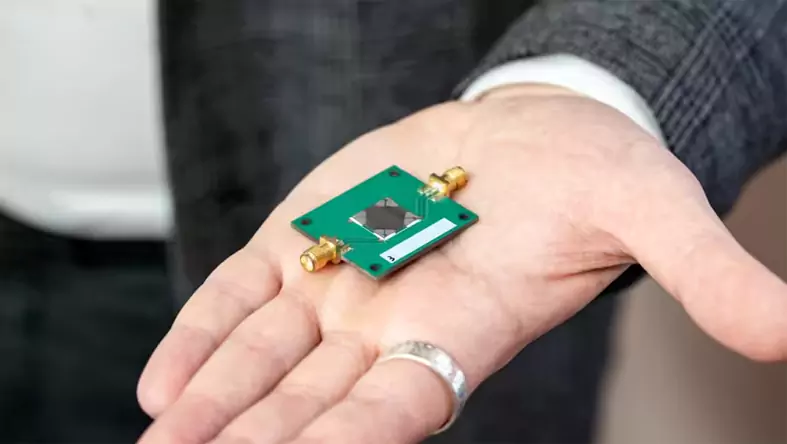
Russian scientists have developed a navigation sensor that requires no external power source.
Scientists from Saint Petersburg Electrotechnical University (ETU “LETI”) have developed a prototype of a non-volatile, highly durable sensor for navigation systems. The sensor is designed to operate reliably under extreme mechanical and environmental conditions.
Unlike conventional MEMS sensors, which are sensitive to mechanical stress, the new device operates on the principle of surface acoustic waves. It consists of a crystal plate made of a durable piezoelectric material that vibrates in response to electric current and responds to changes in temperature, pressure, and acceleration.
As external conditions change, the plate’s vibration characteristics shift, altering the output signal parameters. Analyzing these changes allows for highly accurate determination of an object’s position in space.
According to the developers, the absence of moving parts and the use of durable materials make the sensor well-suited for high G-force environments. ETU “LETI” highlights industrial use cases as the primary target.
The team is currently working on integrating a miniature antenna that will enable the sensor to wirelessly receive power and transmit data simultaneously — making the device completely autonomous.