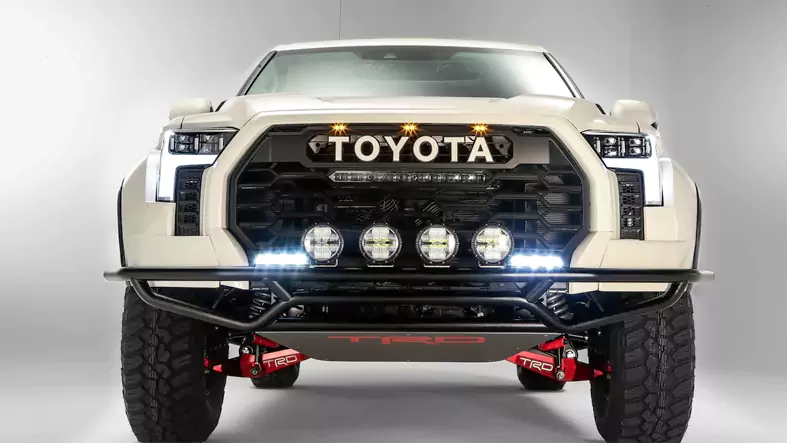
Toyota’s TRD Hammer: Is the Tundra Getting a Raptor Rival?
The high-performance off-road truck segment has grown significantly over the past decade and a half, with manufacturers competing fiercely to offer the most capable, aggressive, and powerful factory-built machines on the market. Ford’s F-150 Raptor is widely credited with pioneering this niche, demonstrating that consumers were willing to pay premium prices — often six figures — for trucks that could tackle extreme terrain straight from the dealership floor, complete with a factory warranty. Ram followed with its own heavyweight contender, the 1500 TRX. Now, all signs point to Toyota preparing to enter this elite arena with a high-performance variant of its popular Tundra pickup.
The Trademark That Started It All
The first concrete clue emerged when automotive researchers at The Drive discovered a trademark application filed with the United States Patent and Trademark Office by Toyota. The filing, submitted just recently, covers the name “TRD Hammer” and applies to “automobiles and structural parts therefor.” While a single trademark application costing $450 might seem like a minor detail, in the automotive world, such filings are rarely made without serious intent behind them. Combined with other emerging evidence, it has set the enthusiast community buzzing with anticipation.
Owner Surveys Hint at the Direction
Adding further weight to the speculation, reports surfaced on Toyota fan forums suggesting that the automaker has been directly polling certain Tundra owners about naming preferences for a potential Raptor competitor. The survey reportedly presented several candidate names, including TRD Pro-S, TRD Baja, TRD Quake, and the puzzling TRD Bizurk — alongside TRD Hammer. While fan forums are not always the most reliable sources, they have historically proven accurate when it comes to early product intelligence of this nature. The fact that “TRD Hammer” subsequently appeared in an official trademark filing lends considerable credibility to what was initially dismissed as speculation.
The name itself carries strong thematic resonance. The annual King of the Hammers event — a grueling desert off-road race held in the American Southwest — is one of the most prestigious and demanding off-road competitions in the world. Naming a performance truck after such an iconic event would be a deliberate and savvy marketing move, immediately communicating the vehicle’s intended capabilities to the target audience.
Spy Shots Confirm Physical Development
Perhaps the most compelling piece of evidence is the appearance of prototype Tundra test vehicles spotted during real-world testing. These spy shots reveal trucks with noticeably widened fenders — a hallmark of serious off-road performance variants, as the wider body accommodates larger tires and long-travel suspension components. Wide-body fenders are not cosmetic additions; they signal meaningful engineering changes beneath the skin. The prototypes also reportedly feature different front and rear bumpers designed to improve approach and departure angles, which are critical measurements for serious off-road performance.
What to Expect Under the Hood and Beneath the Chassis
Industry insiders and analysts have begun piecing together what the TRD Hammer’s specification sheet might look like. Expectations include 37-inch off-road tires, a long-travel suspension system, and the reinforced bodywork already hinted at in the spy shots. These components would position the truck as a genuine competitor to the Raptor and TRX rather than a mere cosmetic upgrade.
On the powertrain front, it is widely anticipated that Toyota would enhance its existing V6-based i-Force Max hybrid system rather than reintroduce a V8 engine. Toyota moved away from V8 power in the Tundra during its most recent generation redesign, and reversing that decision would be unlikely. The i-Force Max hybrid, however, offers a compelling platform — already delivering strong output and torque figures — which engineers could tune further for performance applications. This approach mirrors Ford’s long-standing strategy with the EcoBoost-powered Raptor, which proved that turbocharged six-cylinder engines could satisfy performance truck buyers despite initial skepticism.
The Business Case Is Strong
The commercial logic behind Toyota’s reported move is difficult to argue with. Performance truck variants consistently rank among the most profitable vehicles their manufacturers produce. Ford’s Raptor and Ram’s TRX command substantial premiums over their standard counterparts, and demand has remained robust. For Toyota, which already enjoys strong Tundra sales and a loyal TRD customer base, a halo performance variant could drive showroom traffic, elevate brand perception, and capture buyers currently cross-shopping with Ford and Ram.