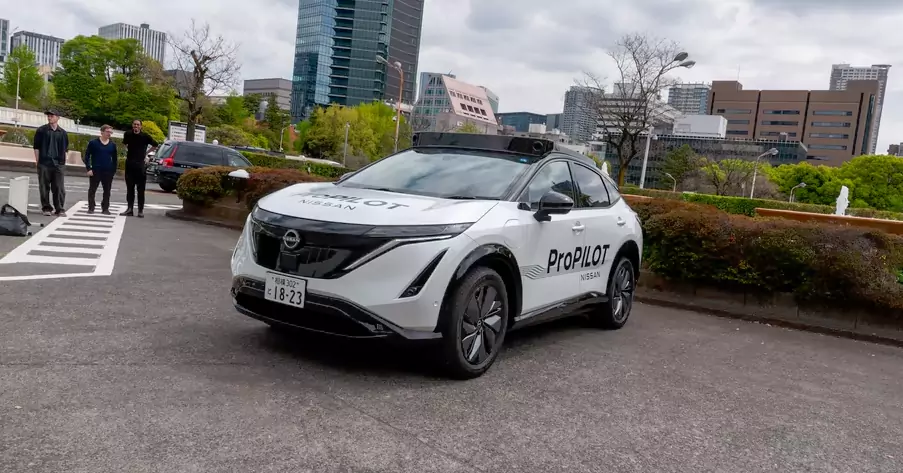
Nissan Advances Autonomous Driving with Next-Gen ProPilot System
Nissan has announced a major leap forward in autonomous driving technology. The company recently tested a new system equipped with lidar, 16 sensors, and advanced AI algorithms in real Tokyo traffic—successfully operating without any driver intervention.
The Japanese automaker is now preparing to introduce the next generation of its Nissan ProPilot Assist system, expected to launch in 2027. According to Nissan, the updated system will approach Level 4 autonomous driving capabilities.
Tetsuya Iijima, Executive Chief Engineer for adaptive safety and software-defined vehicles at Nissan, shared insights about the development. He stated that the new ProPilot system will deliver driving performance comparable to—or even better than—a human driver, and will compete with leading technologies from companies like Tesla and UK-based Wayve.
Advanced Sensor and AI Architecture
The system is built on a significantly upgraded architecture, featuring:
- 11 cameras
- 5 radar sensors
- 1 lidar unit
In prototype models, the sensor suite is mounted on the roof, but in production versions, it will be seamlessly integrated into the vehicle’s body. A newly developed AI-based software stack processes all sensor data in real time.
Real-World Testing in Tokyo
The prototype underwent a 40-minute test drive across Tokyo under real-world conditions, without any pre-defined route. During the test, the vehicle:
- Exited a parking space autonomously
- Navigated city streets and highways
- Responded to traffic signals, pedestrians, and cyclists
- Handled complex scenarios like intersections and construction zones
In one notable scenario, the car encountered a temporary reversible lane controlled by road workers. It correctly stopped, waited for instructions, and safely passed through the narrow section—without any driver input.
Safety-First Driving Approach
Nissan engineers emphasize that the system is designed with a strong focus on safety. In certain situations, it behaves more cautiously than a human driver—for example:
- Stopping earlier at intersections
- Waiting longer at signals if traffic conditions are unclear
This conservative approach is intended to significantly reduce the risk of accidents.
L2++ Classification with L4 Capabilities
Officially, the new ProPilot system will be classified as Level 2++ (L2++), meaning driver supervision will still be required. However, internally, Nissan considers its capabilities close to Level 4 autonomous driving.
This distinction is primarily due to regulatory limitations, as many countries have not yet established laws for fully autonomous vehicles.
Customizable Driving Experience
The system will also allow users to customize driving behavior, including speed preferences—ranging from below the speed limit to slightly above it (up to 15 km/h). This flexibility aims to make the system adaptable to different driving conditions and user preferences.
Launch Timeline and Availability
The technology is set to debut in Japan in 2027, with the next-generation Nissan Elgrand expected to be the first model to feature it. Expansion to other global markets will follow shortly after.
While pricing details have not yet been revealed, Nissan has indicated that it aims to make this advanced technology accessible to the mass market.
Sources: The Drive